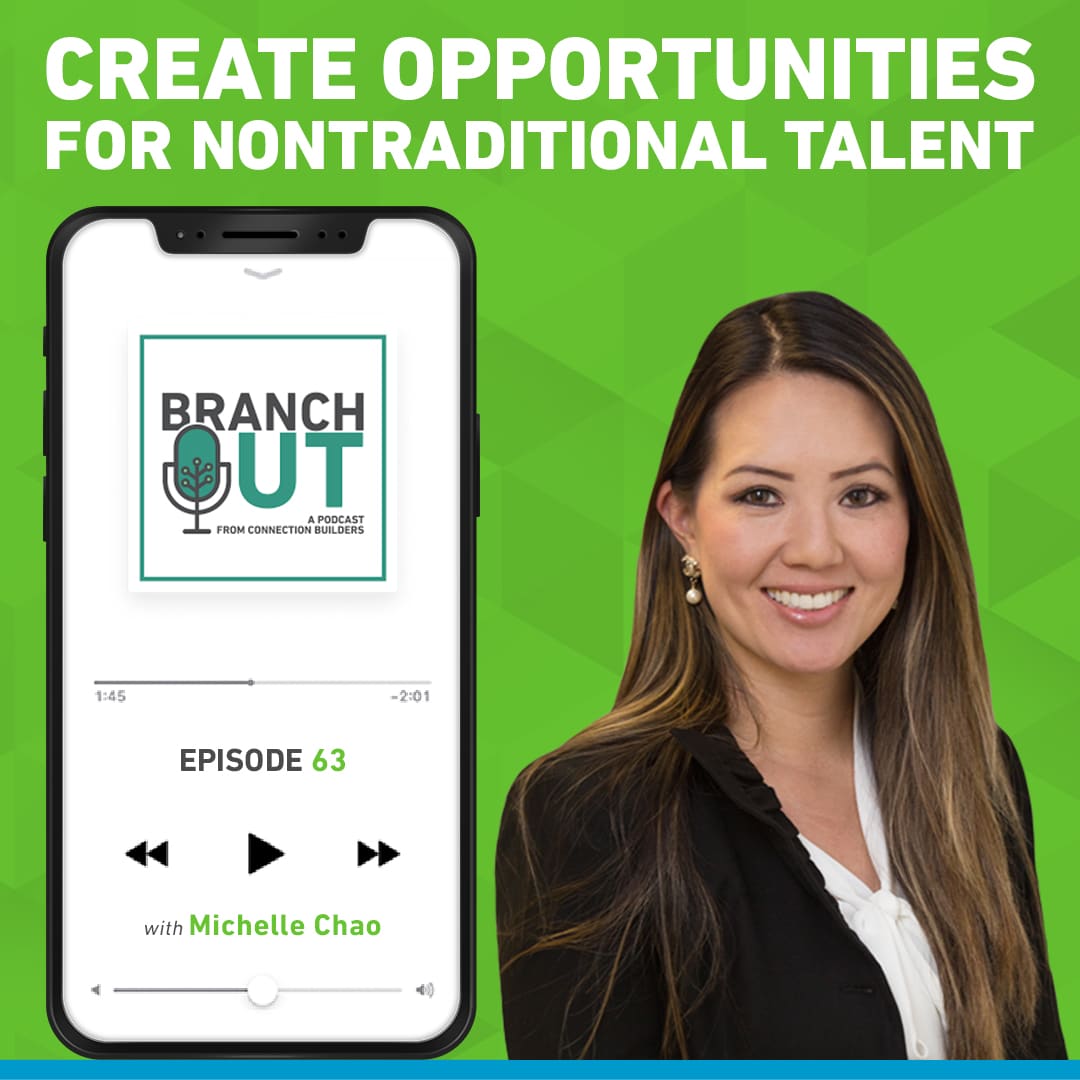
Why this episode
You want a wider talent pool and you keep going back to the same recruiters and the same schools. Michelle Chao started at Bertram Capital as an executive assistant, was told at her interview that the role had no growth path, and is now the firm’s head of investor relations fourteen years later. Her account is useful because it names the two specific things that made the move possible, and both are things a manager controls.
Guest
Michelle Chao is Head of Investor Relations and Senior Vice President of Originations at Bertram Capital, a private equity firm focused on lower middle market companies. She joined when the firm was less than a year old, as an executive assistant supporting business development, and taught herself the technical side through Wall Street Prep and sit-downs with each partner. Her graduate degree is a Masters in Child Education. Find her at linkedin.com/in/michelle-chao-8480024.
Key ideas
A junior person will not tell you they want a different job unless you ask them directly. Chao asks everyone entering Bertram what they want to do and what interests them, and keeps asking as they progress. Her reasoning is that the more junior someone is, the more hesitant they are to raise it, so the burden of starting the conversation sits with the manager.
Exposure is the constraint, not ability. Chao did not know private equity existed when she started; she knew investment banking and venture capital. Bertram now runs an internship pipeline with a local nonprofit, Peninsula Bridge, and has each department present what it does at an all-hands, so people can see that a private equity firm also contains HR, accounting and administration.
Take the hiring risk at the junior level, where the missing attributes can be trained. Chao concedes that going outside the norm for a senior hire is much harder for most firms. Her filter for juniors is work ethic, intelligence and whether the person will stay; everything else, she argues, is teachable over time.
An advocate supplies the belief the candidate does not yet have. Chao did not put herself forward for the investor relations role. Her leadership told her she would be fantastic at it, acknowledged she had no IR background, and offered it anyway. Without that, she says, she would not have known the opportunity existed and would not have seen the potential in herself.
Retention through motherhood was a managerial reaction, not a policy. The first question she was asked was whether she wanted to stay, and only then how it would work. What followed was a negotiation with concrete terms: never more than three nights away in a week, make it up the following week, work from home Fridays.
Chao rejects putting a deadline on diversity recruiting. Bertram’s approach is a standing intent — asking each other continuously whether they know women who might want into private equity — with no expectation of quick results. Her position is that expecting fast results is precisely what makes firms conclude it is impossible and stop.
Notable moments
Michelle Chao: “What my boss at the time told me was, “If you want to get into this development, you have to be the best EA, do your daytime job flawlessly. On top of that, learn the role on your own.””
Michelle Chao: “I’ll also mention that when I interviewed for the EA position, one of the people that interviewed me told me very specifically, “This is an EA role, this will always be an EA role. There is no growth path outside of that.””
Michelle Chao: “Also at that time, there was no other female within Bertram that had a position that required a lot of travel that had a family. I had really no one to compare notes with and no one to show me that it was possible.”
Michelle Chao: “I remember when I got pregnant, I was so nervous to tell him and his first reaction was, “That’s great. That’s amazing. I’m super, super happy for you. What do you want to do?””
Michelle Chao: “I think a lot of organizations are saying, “I need to see someone step above and beyond in order for them to get these opportunities.” On the receiving end, it’s, “I want these opportunities, so I can show that I could step above and beyond.””
Try this
- In your next one-on-one with each person who reports to you, ask what they want to be doing in three years and which department they are curious about. Write the answers down and raise them again at the following review.
- Post your next open role publicly on LinkedIn instead of routing it only through a recruiter, and ask three people in your network this month whether they know a candidate from outside your usual pipeline.
- Pick one person on your team you think has more in them than their current seat allows, and tell them so this week, naming the specific role you can see them in.
Themes
Transcript
Read the full transcript
[INTRODUCTION]
[00:00:02] Announcer: Welcome to the Diversity Matters in the Middle Market Podcast, where industry leaders share their compelling growth stories and the unseen challenges they have overcome. Our goal is to inform and inspire our listeners to take action and make diversity, equality and inclusion a pillar of your organization. This is a production of the Association for Corporate Growth, ACG and Connection Builders
[EPISODE]
[00:00:24] Alex Drost: Hi, everyone. Welcome to an episode of the Diversity Matters in the Middle Market Podcast. I’m your host, Alex Drost. Today we’re joined by Michelle Chao, Head of Investor Relations and Senior Vice President of Originations with Bertram Capital, a private equity firm focused on lower middle market companies. Michelle shares her non-traditional career pathway to her current role, and we discuss how firms can build a culture that creates opportunities for a more diverse talent pool. All right. Let’s jump in.
Michelle, welcome to Diversity Matters Podcast. Excited to have you here today.
[00:00:59] Michelle Chao: I’m excited to be here.
[00:01:00] Alex Drost: Let’s start out with just sharing a little bit of your background, a little bit of your story. I think you have a pretty inspiring story, and then we’ll take the conversation from there.
[00:01:08] Michelle Chao: Yeah, absolutely. I have been with Bertram Capital for, I will say, 14 years now. I started from a very unique position, actually started as an EA and Bertram was less than a year old at the time. They were really looking for support to help develop the firm, asked me what I wanted to do later on in life and I wanted to be an EA. [Inaudible 00:01:29] about saying no about that and they gave me opportunities to grow. I had been supporting business development as an EA. I was really, really intrigued with the private equity world with deal sourcing, with how we grow businesses and sell, how we think about things. Meeting with management teams, it was all just so intriguing and it was one of those things where I didn’t realize this would be something I’m so passionate about. I found that passion and I was given opportunities. Today, 14 years later, I’m the Senior Vice President of Business Development, and I head Investor Relations at Bertram.
[00:02:02] Alex Drost: Wow! To be clear, you had no educational background, no previous experience in the private equity world. Correct?
[00:02:09] Michelle Chao: Not in private equity. Prior to Bertram, I actually worked on the real estate side. I did valuations, so I understood certain aspects. Prior to that, I had worked for an international holding company that managed multiple assets. But again, the first company was more in an EA role, the [inaudible 00:02:27] equity. But what I found was a lot of experiences and things that I learned in my previous roles really carried over into my current role.
[00:02:36] Alex Drost: Let’s progress then to where you are today.
[00:02:38] Michelle Chao: It was probably a year into my time at Bertram. I think I was a good EA. I think I was a good enough EA, where I was asked, “What do you want to do with your life?” You work really, really hard. The great thing about Bertram at that time was, because it was a new firm, there was a lot of ways for me to add value and there was a lot of ways for me to bring up ideas on how we can improve marketing in this area. I was really, really organized. So when I was asked what else I want to do, I realized during that position that I really wanted to learn more about business development, that I really wanted to dig in. What my boss at the time told me was, “If you want to get into this development, you have to be the best EA, do your daytime job flawlessly. On top of that, learn the role on your own.” I did that. I took Wall Street Prep to learn the kind of financial engineering side. I sat down with all the partners within Bertram, learned about our portfolio, and our investment strategy and it just became second nature.
[00:03:43] Alex Drost: You developed the skill sets, you put in the extra work to learn that. It allowed you to get to where you are today, in very much a non-traditional path to getting into your role, right? What have you learned?
[00:03:56] Michelle Chao: Something that I do now whenever anyone enters into Bertram is I always ask, “What do you want to do? What are you interested in?” I think Bertram in general has done a pretty good job of this, where we will share what other departments do within the firm, and if there’s interest, we have open conversations. I think that’s something that I’ve learned is sometimes people are probably going to be – especially if you’re more junior level, they’re going to be more hesitant to explore different areas so creating a safe place to have those open conversations is something that I’ve learned from a management level. The other thing that I learned is that nothing is out of your reach if you’re willing to put in the effort. I think right now, I have my dream job.
Fourteen years ago when I started at Bertram, if this would be where I was going to end up, I would probably say, “There’s no way because I don’t have the background. They’re so amazing and they’re so, so smart.” I always felt like the dumbest one in the room. The other thing I’ve also learned is that everyone’s learning as they go. That has helped me a lot and you realize that you’re continuously growing, you’re continuously learning. That empowers you to get better and better. So those are kind of a wide range of things I’ve learned.
[00:05:01] Alex Drost: Let me take you back to, you talked about that you have to be open to helping people see new opportunities run the firm, right? That’s a little bit of you, in your role, you start there. You’re in an executive assistant role. The career track certainly is not typical to move into where you are today. But if I hear you, right, someone sat down, it’s a safe place to understand what some of those other opportunities were that could inspire you and motivate you to go above and beyond, to learn the skill sets necessary to grow. Is that a fair way of looking at that?
[00:05:30] Michelle Chao: That is absolutely fair. I’ll also mention that when I interviewed for the EA position, one of the people that interviewed me told me very specifically, “This is an EA role, this will always be an EA role. There is no growth path outside of that.” I was young enough and green enough where I thought, “Well, this is still something that I want to take on and I have the skills, I think I could do this.” But as I was exposed to more and more PE, I just wanted more and I was given more because I was willing to work for it.
[00:05:58] Alex Drost: You would also mention that not everyone knows all the opportunities available. I think a little of what you’re describing there, when you started, you didn’t have a clue of what it could lead to or where it could take you, right. Knowing that now, how do you create an environment? How do you make sure that you help people understand some of the different opportunities that might be available?
[00:06:16] Michelle Chao: I can speak from our personal experience at Bertram. We started working with a local nonprofit organization called Peninsula Bridge. Essentially, we will hire an intern from them just about every year. Where when they come in, we ask them, “What you want to learn?” and we have them sit down with different departments and we expose them to different areas within private equity. Because within private equity, there’s also HR, there’s also administrative, there’s also accounting. There are so many different facets within a private equity firm. I think we have this organization that enables people to have so much exposure. That’s one way we’ve kind of given opportunities.
The other too, which is really great to be able to have all hands meetings virtually, is we actually had each department do a presentation on what they do, and made – gave this part of Bertram, contact this person. Generally, you’re creating a lot of camaraderie, and you’re creating just this really cohesive environment where everyone works really well together, everyone knows why this part of the firm is important and it’s much more collaborative. Then, people can also assess whether or not they want to learn more or develop their skills in a specific area.
[00:07:23] Alex Drost: Let’s tack onto that. I want to turn this conversation now towards specifically around diversity. Our whole theme for this episode or for all these podcasts here is around diversity, and why diversity matters and how it impacts an organization. A lot of what you and I have talked about, what I think is really interesting here is that if you really want to build a diverse team, you often do need to look outside of traditional ways, you have to find ways to bring up people that might not come from a traditional pathway. Everything you’re sharing is about how to create that, how to create opportunities for people that aren’t coming from a traditional pathway. Speaking from your experience around this, what are some of the benefits that you’ve seen come through or extra benefits, things that often ultimately help the organization function better, because of this way of thinking?
[00:09:38] Michelle Chao: Well, I can say that, early on in Bertram, we used to only use recruiters to hire for positions within Bertram. I think in the recent years, we’ve started posting on LinkedIn. It’s creating a broader avenue for people to come in, apply for open positions within Bertram. I think that’s one way. Then the other is taking on interns that don’t have that typical background and just giving them a shot. I think for a lot of firms, it’s going to be much more challenging to go outside of the norm for a more senior position. But if you have junior positions where you can really build them up within the firm, and they have a lot of attributes that you like, and not every single one that typically checks the box, you know, take a risk with the junior ones. For me, I think it’s really important to hire people that are willing to work hard, that are really, really smart, that are going to be with you long term. Those are who you want to invest in, and a lot of the other attributes can kind of be trained throughout time.
[00:09:05] Alex Drost: I think your point there and you said this earlier that you can learn anything. People can reach and accomplish your goals as long as you try to – as long as you embrace the mentality of being a constant learner, looking to invest in yourself, looking to grow your skill sets. Remind us again, what’s your education background?
[00:09:22] Michelle Chao: I went to UC Davis for my undergrad and then I actually ended up getting a Masters in Child Education, which is totally random, but it was – actually, it was partially because I didn’t know if I could be successful having a family and having such a demanding job at the same time.
[00:09:40] Alex Drost: Really? Well, it’s fascinating. I want to actually come back to that point, again. But I want to point out that your educational background, I ask our listeners who are listening here, think of our community, especially talking to the ACG community here. Look around at how many people do you know that have a Masters in Child Education that is working in your position, right? You’re probably one of, if not the only, right? But what it proves is that your educational background, while it certainly has an impact on what you know and how you can perform in the workplace, it certainly is not the only factor. It’s not the only variable that drives success, because you’ve been successful in your role without that traditional education and experiential background that most people traditionally have going into a private equity role. Correct?
[00:10:23] Michelle Chao: Right. Correct. That is a fair assessment.
[BREAK]
[00:10:31] Announcer: Today’s episode is brought to you by Connection Builders, helping middle market professionals connect, grow and excel in their careers.
[INTERVIEW CONTINUES]
[00:10:38] Alex Drost: Now, for you, looking back at that, what do you wish you would have known then that you know now?
[00:10:44] Michelle Chao: Well, definitely just having more exposure, because I think back then, I didn’t know what private equity was at all. I knew what investment banking was, I knew what venture capital was. I think just having more exposure to different career opportunities within this world, and even within private equity. I mean, there’s the investment side, and then there’s business development IR where I stand. I don’t think I would be as passionate about the investment side within a specific sector, but I’m super passionate about the IR and business development side as well. I think it’s kind of probably being more educated on all the opportunities available to me, and giving myself more exposure to that early on.
[00:11:23] Alex Drost: I think that’s a really important point there. Again, for listeners, if you’re in a role, if you’re in a position where you are in a, whether it be private equity, investment banking, legal, accounting, wherever you are in the ecosystem, if you can look for opportunities to expose other individuals, specifically those that are earlier in their career trajectory, and help them understand what some of the opportunities out there might be. I think, so often, you can have a talented individual that didn’t follow a traditional education pathway, that doesn’t even have a clue that that opportunity exists out there. There might be a role out there. If they don’t know it, they’re never going to just figure it out unless someone helps them, and sees it and shows that opportunity. Everything you’re saying is, just have exposure, help people. If you’re in that position, look for ways to give people exposure to what you’re doing. And in particular, and tying it to this conversation, look for underrepresented minority groups and say, “Okay. How can I find someone and help them see this opportunity that may not exist in their world today?”
[00:12:24] Michelle Chao: Right. Agree. I will also say. Just an example, kind of within my own personal career path was, I started in business development, and Bertram was looking for someone to potentially jump into the IR role. It was, again, my boss and my leadership, the person above me who said, “I think you would be fantastic for this role. This is something that’s brand new, you have the energy for it. You know Bertram super, super well. I know you don’t have a background in IR, but I think you could do this.” For me, I had an advocate, I had a cheerleader encouraging me to step into this role, because they saw a certain potential in me that I wouldn’t have seen in myself and there was this opportunity that I wouldn’t have known have had it not been for my senior leadership.
[00:13:11] Alex Drost: The point I think you’re driving, and it’s an important one is, again, not only try to create exposure for others but if you see someone that you think has potential, be an advocate for them. Help them see that, because oftentimes, someone may not see their – I think oftentimes, we don’t see them. I think that’s human nature, is to not fully see your own potential. And when you have someone that can advocate for you, and help you see that it can go a long way in motivating you, and helping you kind of break through your own challenges.
[00:13:38] Michelle Chao: Totally. Exactly.
[00:13:39] Alex Drost: Let’s go back for a moment. You got a degree in childhood education because you didn’t know if you could handle being a mom, and doing the work. I want to talk about that for a minute. I think there’s a lot of women out there that have that exactly – can you just share some of your thoughts, your experience around that, and what you would say to other women going through that same thought process right now?
[00:13:58] Michelle Chao: Yeah, absolutely. My role within business development and now also in investor relations pre-COVID required a ton of travel. You are unable to travel for a specific amount of time and as a mom, you don’t want to be away from your children for a very, very long. Also at that time, there was no other female within Bertram that had a position that required a lot of travel that had a family. I had really no one to compare notes with and no one to show me that it was possible. When my situation, I think I have proven that I was valuable to the firm where when I got pregnant the question was, first and foremost, “Do you want to stay?” and I wanted to stay. So the question was, “Okay. Then how are you going to make it work?” Knowing that your performance can’t go down, knowing that you have to continuously source opportunities and bring in investors and.
The responsibility was then placed on me in terms of, okay, if I want the best of both worlds, how am I going to make it work? It was a candid conversation I had with my firm, with my husband and we found a way to make it work. We got a nanny. We made sure that I would never be away from home for more than three nights out of the week and then the next week, I would make up for it. We decided that I would work from home on Fridays. I can take my kids to their music lessons and do all the things that I want to do as a mom, but also still continue to be successful in my role and I have a lot of flexibility. If I need to leave the office early for something to do with my kids, my firm has the confidence, virtuosic competence that I’m still going to get the work done and I live up to that. I make sure that I get everything done and performance hasn’t gone down. Just because you don’t see it today, doesn’t mean it can’t be available. It’s not possible. You just have to really think about how to make it possible.
[00:15:46] Alex Drost: Well, and I think you said this to me on a previous call and this goes back to advocating a little bit. I think you had someone in your organization said, “I’d rather have half of Michelle instead of no Michelle.” It’s advocating and getting you like, “Okay. How can we help, how can we make this work for you, kind of thing.”
[00:16:01] Michelle Chao: Yeah, exactly. I’m still going to give him a shout out because I think he deserves it. But David Hellier is the person that I’ve been working with for over a decade. I remember when I got pregnant, I was so nervous to tell him and his first reaction was, “That’s great. That’s amazing. I’m super, super happy for you. What do you want to do?” It was so refreshing to have that open conversation, and to be able to have someone who was happy for me even though the position – my role may impact the professional role. I felt like I had a cheerleader and I wanted to do a good job because of that too.
[00:16:40] Alex Drost: Well, I think this is a really important point for listeners and thinking of, again – especially if you are in a position of influence, you’re a leader within an organization to create the culture that their response is, “That’s great. I’m excited for you. How can we make this work for you? This is so cool.” Because what I heard you say and I don’t think you’re alone in this at all, you had some like some angst about talking about it at first because you were worried about what the response might be to it and it’s unfortunate that is the reality that many times, that can be some of that culture in some organizations. But the point you’re driving is, because David had created a culture, and an environment and a situation for [inaudible 00:17:17] it was, “You can do this. How do we make this work?” and really being that advocate for you. It gave you the space, and the opportunity to figure it out and to continue to excel, which allowed your firm to retain you as a highly valued member of the team. Correct?
[00:17:34] Michelle Chao: Correct. Yes. I hope I’m highly valued, at least so. Yes.
[BREAK]
[00:17:43] Announcer: Today’s episode is brought to you by the Association for Corporate Growth, the premier M&A deal making community with a mission to drive middle market growth.
[INTERVIEW CONTINUES]
[00:17:54] Alex Drost: Let’s talk just a little bit then for someone who is trying to step back and say, “Okay. Well, I want to build a more diverse team. I want to bring in more talent. I know that I need to find exposure. I know I need to advocate. I know I need to try to create these. What do you say to someone who is saying, “Well, I’ve got all this, but it’s just – how do I find the time? How do I make this work? It just seems really hard to build a diverse team and it just seems easier not to deal with it”?
[00:18:22] Michelle Chao: Well, I think if you have that attitude of, “It’s not going to happen” or “It’s impossible,” then you already have the wrong attitude. I think it’s a scenario where, if you want to pursue a path and you’re focused on it, you’re just continuously building on top of that. For instance, for Bertram, we have an effort. We want to make sure we recruit more women. We’ve been asking each other, “Do you have women in your network that might be interested in getting into private equity?” It might not bear fruit right away. But over time, if you continuously have this acknowledgement that you want to build a certain team where you want to attract a certain talent, eventually, something’s going to happen. Eventually, you’re going to find someone.
I think it’s – first and foremost, having the can-do attitude, not necessarily setting a time limit and understanding that it is an ongoing effort. If you stick to it, at some point, you’re going to create a more diverse team, because you put it out in the universe and the universe at some point is going to return what you’re asking for.
[00:19:16] Alex Drost: I completely agree with you. You have to have the right attitude about it. Starting with that mindset is critical behind it, but you also said, it sounds like there’s a little bit of intentionality within your organization saying, “Okay. We want to hire more women. We want to expand the women representation across the firm. So, we’re going to ask into our network and be very thoughtful about seeking out that talent,” knowing that it’s not going to happen overnight, knowing it’s not going to just change right away, that it’s going to take time and effort over a duration. But you’re making that effort, you’re putting that intentionality out there to start that process.
[00:19:50] Michelle Chao: Correct. Exactly.
[00:19:52] Alex Drost: Well, Michelle, I think that’s great advice here. Let me give just kind of a quick summary of what we talked about and tie this whole conversation together here. Again, you started your career within Bertram as an EA, started a role that wasn’t supposed to have upside necessarily, and you came in without a traditional education and career path background. Fast forward 14 years to where you are today, you’ve excelled within the career, you’ve built within the firm, you’ve built a career around it, and you’ve taught yourself, you’ve learned along the way. What I’ve heard from you throughout this conversation is what really helped you be successful and that is really two key components.
Number one, it was exposure. Number two, it was advocacy, right? It was being exposed, understanding some of the different options, knowing what was out there, and then having an advocate in there. Then of course, under that is your own drive, your own grit, your own hard work and everything that has to go in there. Obviously, I don’t want to it all discount that, because you worked very hard to get where you are. But it sounds as I’ve heard you, having the exposure, and having an advocate is what really helped bring what I would say, your very nontraditional talent into that process. That’s how we can open up more doors and create more opportunities for those that aren’t coming from that traditional career pathway.
[00:21:09] Michelle Chao: Yes. Yeah. I think that’s a very good summary. I also think it’s very much a chicken egg thing for a lot of organizations, for a lot of people, because I think a lot of organizations are saying, “I need to see someone step above and beyond in order for them to get these opportunities.” On the receiving end, it’s, “I want these opportunities, so I can show that I could step above and beyond.” I think for me, I had this kind of perfect alignment where I was going above and beyond, and there was a need for this role to be fulfilled and it just kind of melded together. I think in everything, it’s just – if you want to have additional opportunities, if you want a more diverse team, putting it out in the universe, doing what you can to achieve that, and then hopefully, all the stars will align.
[00:21:55] Alex Drost: Your chicken and egg comment is a very good one. You have to create the opportunities; you have to take some risks on people and open up doors and give them the opportunity to shine to figure out if they can actually shine sometimes and it’s part of the process. Michelle, I really appreciate you coming on here. I appreciate you sharing some of your thoughts. For our listeners, how can they get in touch with you?
[00:22:15] Michelle Chao: I’m on LinkedIn. Feel free to ping me on LinkedIn. You can go on the Bertram Capital website too, www.bcap.com. Our office number is there, but feel free to reach out anytime.
[00:22:25] Alex Drost: Awesome. We’ll make sure that’s linked in the show notes below. Thanks, Michelle. Appreciate you being on here today.
[00:22:29] Michelle Chao: Thanks so much.
[END OF INTERVIEW]
[00:22:31] Announcer: Thank you for tuning in to today’s episode of the Diversity Matters in the Middle Market Podcast. We hope you enjoyed our content and encourage you to take action today. While no individual will bring all the change necessary, we can all make an impact. If you enjoyed our content, please share with your network. This is a production of the Association for Corporate Growth, ACG and Connection Builders.
[END]